
Some conveyor belts just need to move light boxes across a warehouse floor. Others are hauling coal out of a mine shaft where one spark could turn into a disaster. That second job needs a different kind of belt altogether, and that’s where the PVC solid woven conveyor belt earns its reputation. It’s built for situations where safety isn’t optional, durability isn’t a bonus feature, and how the material is handled actually matters to the people standing near the belt.
This type of belt shows up a lot in mining and heavy industrial settings, and once you understand how it’s built, it’s easy to see why operators keep choosing it over lighter alternatives.
Fabric Reinforced PVC Solid Woven Conveyor Belt
Cover Grade: Flame Retardant Industrial Heavy-Duty Abrasion Resistant
Primary Application: Underground Coal Mining & Mining Industry
1. Product Introduction
This fabric-reinforced PVC solid woven conveyor belt is a heavy-duty industrial conveying solution purpose-built for underground mining operations, especially coal mines with strict flame safety requirements. It integrates solid woven fabric reinforcement with flame-retardant PVC compound, delivering reliable performance in gassy, dusty and high-wear underground mining environments.


2. Construction Structure
The belt adopts an integral composite manufacturing process as defined by standard solid woven conveyor belt technology:


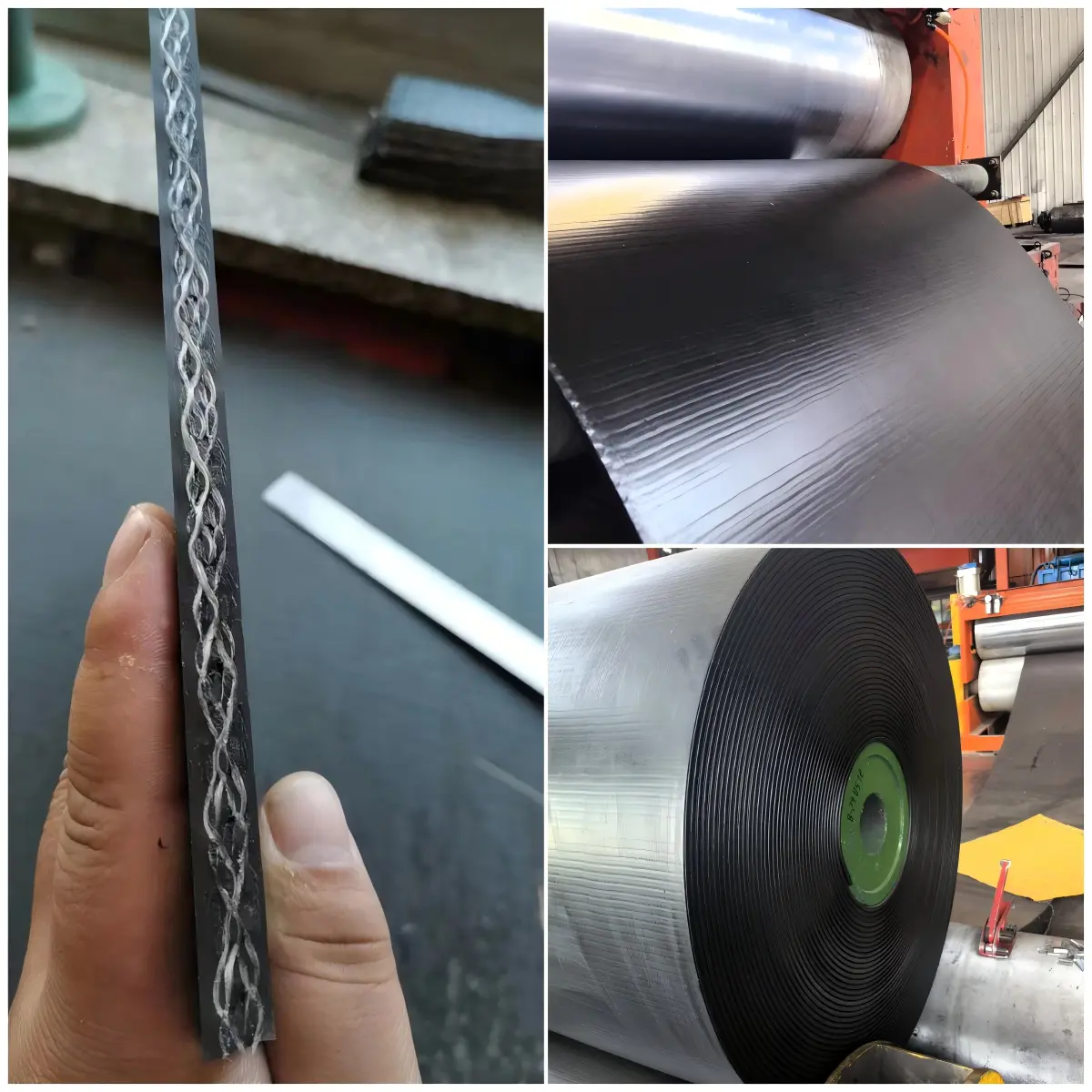
- Reinforcement Carcass: High-tenacity solid woven textile fabric fully impregnated with PVC paste, ensuring uniform load distribution and high structural integrity.
- Top & Bottom Covers: Abrasion-resistant flame-retardant PVC covers, bonded to the carcass through vulcanization to provide surface protection against wear, impact and corrosive mining materials.
Once that woven core is done, it gets coated and impregnated with PVC. The coating seals the fibers, protects them from moisture and abrasion, and gives the belt its flame-resistant character. This is a very different approach from standard fabric conveyor belts, which rely on rubber compounds between plies and don’t offer the same resistance to tearing or splitting.
3. Core Performance Features (Mining-Oriented)
3.1 Flame Retardant & Antistatic Safety Performance
As a safety-critical product for underground coal mining, the belt formulation achieves excellent flame resistance and static dissipative properties:
- Self-extinguishing flame behavior, preventing fire propagation in confined mine spaces
- Permanent antistatic property to eliminate static spark hazards in methane-laden mine atmospheres
- Meets international mining flame retardant standards for underground use
3.2 Heavy-Duty Mechanical Performance
- Excellent impact resistance and tear/rip strength, suitable for conveying sharp-edged bulk materials such as raw coal, gangue and mine rock
- Low elongation at break (minimum 15% warp, 18% weft) for stable belt tracking under long-run heavy load conditions
- Pressed PVC cover option (up to 4 mm thickness) provides extended wear life for severe mining applications
3.3 Operating Adaptability
- Suitable for dry underground conveying conditions with a maximum inclination angle of 16°
- Compatible with standard mining conveyor pulley systems and idler configurations

Key Applications of PVC Solid Woven Conveyor Belts
Underground Mining


This is probably the most obvious use case, and for good reason. Underground coal mines are exactly the kind of environment where a fire risk can escalate fast, with limited ventilation and limited ways to escape. A belt that resists flame propagation isn’t a luxury down there, it’s part of the basic safety plan.
PVC solid woven belts are used to move coal, ore, and other mined material along haulage routes that can run for kilometers underground. The belt needs to hold up to constant loading, occasional impact from larger chunks of material, and the humid, dusty conditions typical of a mine shaft. The solid woven construction handles that combination better than most alternatives, which is why you’ll see it specified in mine safety regulations in several countries rather than just recommended as good practice.


Material Handling in Mining Facilities
Mining isn’t only about what happens underground. Above ground, at processing plants and stockyards, belts are still moving huge volumes of raw and semi-processed material between crushers, screens, storage areas, and loading points.
These sections deal with a different kind of stress. Abrasion is the main enemy here, since ore and aggregate are naturally rough on belt surfaces. A belt running for years in this kind of setting needs a surface that can take that wear without needing constant replacement. The woven core adds a layer of structural toughness that plain rubber belting doesn’t have, so operators get more consistent uptime and fewer unplanned stops for repairs.
Reliability actually matters more here than people expect. A processing facility that has to shut down a line because of a belt failure loses far more in downtime than it would have spent on a better belt in the first place.
4. Technical Parameter Table (Standard PVC Flame Retardant Grade)
| Belt Grade | Tensile Strength (Warp) | Tensile Strength (Weft) | Carcass Thickness | Carcass Weight | PVC Cover Thickness (Top+Bottom, recommended) | Min. Pulley Diameter |
|---|---|---|---|---|---|---|
| Unit | N/mm | N/mm | mm | kg/m² | mm | mm |
| 680/I | 680 | 265 | 6.5 | 8.5 | 1.5 + 1.5 | 400 |
| 800/I | 800 | 320 | 6.9 | 9.0 | 1.5 + 1.5 | 500 |
| 1000/I | 1000 | 350 | 7.5 | 9.7 | 2.0 + 1.5 | 630 |
| 1250/I | 1250 | 350 | 8.5 | 11.0 | 2.0 + 2.0 | 750 |
| 1400/I | 1400 | 350 | 9.0 | 11.5 | 3.0 + 2.0 | 750 |
| 1600/I | 1600 | 450 | 9.5 | 12.3 | 3.0 + 2.0 | 800 |
| 1800/I | 1800 | 450 | 10.0 | 13.0 | 3.0 + 2.0 | 800 |
| 2000/I | 2000 | 450 | 10.5 | 13.6 | 3.0 + 2.0 | 1000 |
| 2500/I | 2500 | 450 | 12.5 | 14.5 | 3.0 + 2.0 | 1200 |
| 3100/I | 3100 | 450 | 17.0 | 17.0 | Customized | 1500 |
| 3500/I | 3500 | 500 | 20.0 | 19.0 | Customized | Consult factory |
Data source: Sharda Cropchem PVC solid woven conveyor belt technical datasheet. All grades are available in flame retardant formulation for mining applications.
5. Standards & Flame Retardant Compliance
The product conforms to major international standards for mining conveyor belts, verifying its underground safety qualification:
- DIN 22109: German standard for flame-retardant and antistatic conveyor belts for underground mining – the widely accepted benchmark for coal mine safety approval
- AS 4606: Australian standard for fire-resistant conveyor belts for mining operations
- SABS 971: South African national standard for flame retardant conveyor belts used in mines
6. Typical Mining Applications
- Underground coal mining: face conveyors, gate road conveyors and main haulage systems
- Coal handling and preparation plants
- Underground metal mines with fire safety requirements
- Bulk material transport in dusty, gassy and high-abrasion mining environments
Technical References
- Sharda Cropchem Ltd. (2026). PVC / PVG Solid Woven Conveyor Belts – Technical Specification. Retrieved from https://shardacropchem.com/pvc-pvg-conv-belts/
- DIN 22109:2019. Conveyor belts for underground mining – Flame retardant and antistatic conveyor belts – Requirements and test methods.
- ISO 14890:2017. Conveyor belts – Solid woven conveyor belts with covers – Specification.Other Industrial Applications
Mining gets most of the attention, but PVC solid woven belts show up elsewhere too. Any operation that deals with heavy, abrasive, or chemically active materials, and needs a belt that won’t easily tear or absorb moisture, is a reasonable candidate.
Quarries, cement plants, and some heavy manufacturing lines use similar constructions for the same reasons: strength under load, resistance to punctures, and a flatter, more predictable operating life compared to lighter belt types. The right fit always comes down to the specific combination of material being handled, how the conveyor is designed, and what conditions the belt will actually run in day to day. A solid woven pvc conveyor belt isn’t a universal answer, it’s a strong answer for a particular set of demanding conditions.
How Safety Requirements Influence Belt Selection
Flame resistance isn’t something you add after the fact. It has to be built into the belt from the start, through the coating material and the way the carcass is constructed. That’s precisely why solid woven belts with PVC coating get specified so often in underground and confined operations, the construction method itself supports the safety requirement instead of just meeting a minimum standard.
Different regions and industries have their own testing standards for flammability, electrical conductivity, and drum friction resistance, and mining operations in particular tend to follow strict versions of these. Buyers should be checking a belt against the actual certifications that apply to their site rather than assuming any belt labeled “flame resistant” automatically clears the bar.
This is where a lot of buying decisions go wrong. People pick a belt type because it worked somewhere else, without checking whether it was actually rated for the conditions at their own site. A belt that’s fine for a surface quarry might not meet the requirements for an underground coal seam. Matching the belt’s actual specifications, not just its general category, to the operating environment is the part that protects people and equipment. That means looking past the product name and reading the technical data sheet, checking test certificates, and confirming the belt was rated for conditions similar to yours, not just similar in general terms. Anyone specifying a chevron conveyor belt for an incline application runs into the same issue, the pattern solves an incline problem but doesn’t automatically solve a flammability or abrasion problem too.
Factors to Consider Before Choosing a PVC Solid Woven Conveyor Belt
A few practical things are worth working through before settling on a belt for any mining or heavy industrial job.
Material being conveyed. Sharp, abrasive material wears differently than fine powder or wet, sticky loads. The belt surface and cover thickness both depend on what’s actually going across it.
Conveyor length, loading conditions, and speed. Longer runs put more tension through the belt, and higher speeds increase wear at loading and transfer points. These numbers directly affect what belt strength you actually need.
Required strength and resistance properties. Tensile strength, tear resistance, and flame resistance ratings should match the real demands of the job, not just a general industry assumption about what “should” work.
Site conditions and safety requirements. Underground versus surface operation, ventilation levels, and local safety codes all shape which belt specification is actually compliant, not just functional.
Getting these details right before ordering saves a lot of trouble later. A belt that’s under-specified for its conditions tends to fail early, and replacing a belt mid-operation is far more disruptive and expensive than getting the spec right the first time.
If you’re working through these decisions for a specific site or application, it helps to talk through the actual operating conditions with someone who deals with this daily. Connect with us and we can help figure out what belt construction actually fits what you’re running, based on your material, your conveyor setup, and the safety standards you need to meet.