
Floor space is one of those things everyone underestimates until they run out of it. When a plant needs to move material up a level, or across a gap where a flat belt just won’t hold its load, a standard conveyor often can’t do the job without eating up a huge footprint. A corrugated sidewall belt conveyor solves that problem in a way flat belting simply can’t, and it’s become one of the more practical tools for operations dealing with tight layouts and vertical transitions.
Corrugated Sidewall Conveyor Belt :
The latest addition to the vast range of Sharda Conveyor Belts is The Corrugated Sidewall & Cross Cleats Conveyor Belts which have found acceptance with many of our existing customers.
Advantages :
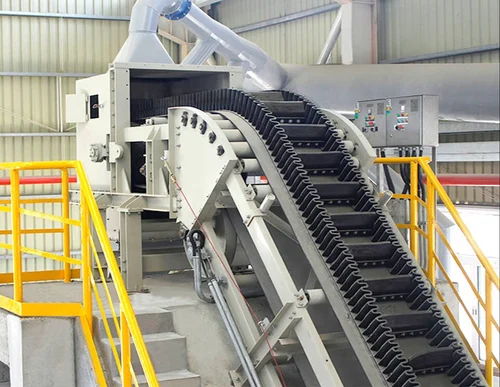
Corrugated sidewall conveyor belt (Xe Sidewall Conveyor Belt Xesc Sidewall Conveyor Belt Steep Angle Sidewall Conveyor Belt) is one of the most effective ways of elevating materials in a confined space, the economy is achieved by single belt operation, wide range material can be handled, less space requirement, no transfer point, low maintenance and big capacity. Corrugated sidewall belt can be designed into a set of complete transportation system according to application.
Sidewall conveyor belt used for conveying material, particularly useful when the inclination angle of the elevation system is very steep.
Its strength is given by the increasingof handling capacity, the absence ofmaterial spillage, the low power andmaintenance required.
The main application fields of thisbelt are.
-Steel plants
-Mines
-Cement Plant
-Foundries
-Batching plants
-Power plants
-Tunneling
Base Belt Structure:
Four parts: Top cover rubber; Bottom cover rubber; Reinforced core; Cross rigid.
Thickness of top cover rubber: 3-6mm
Thickness of bottom cover rubber: 1.5-4.5mm.
Belt core: Cotton, Nylon, EP or Steel Cord
The Width is the same as normal belt.
Cleat types: T, TS, C , TC and TCS The cleat is made of enforced fabric, solid, anti-shock to avoid distortion.
“TS and TCS” cleat are normally used for abrasion condition.
“T and TS” cleat are normally used up to 40°C, “TC and TCS” are normally used from 40° to 90°C.
Sidewall, cleat and base belt are joined through hot vulcanization.
Cleat and sidewall are joined through bolt to prevent leakage

What Makes a Corrugated Sidewall Belt Conveyor Different?
A regular conveyor belt is flat. Load it up too steeply and material just slides back down. A Corrugated sidewall belt conveyor gets around that limitation by combining a base conveyor belt with raised, flexible sidewalls running along both edges, and often cleats across the belt surface as well.
The sidewalls are corrugated so they can flex around the pulleys at each end without cracking or losing their shape. That flexibility is what makes the whole system work on a continuous loop rather than needing separate flat and inclined sections.
Once material is loaded onto the belt, the sidewalls act like containment walls. Combined with the cleats, they stop bulk material from rolling back or spilling off the sides as the angle increases. A flat belt has no answer for that problem beyond keeping the incline shallow, which isn’t always practical.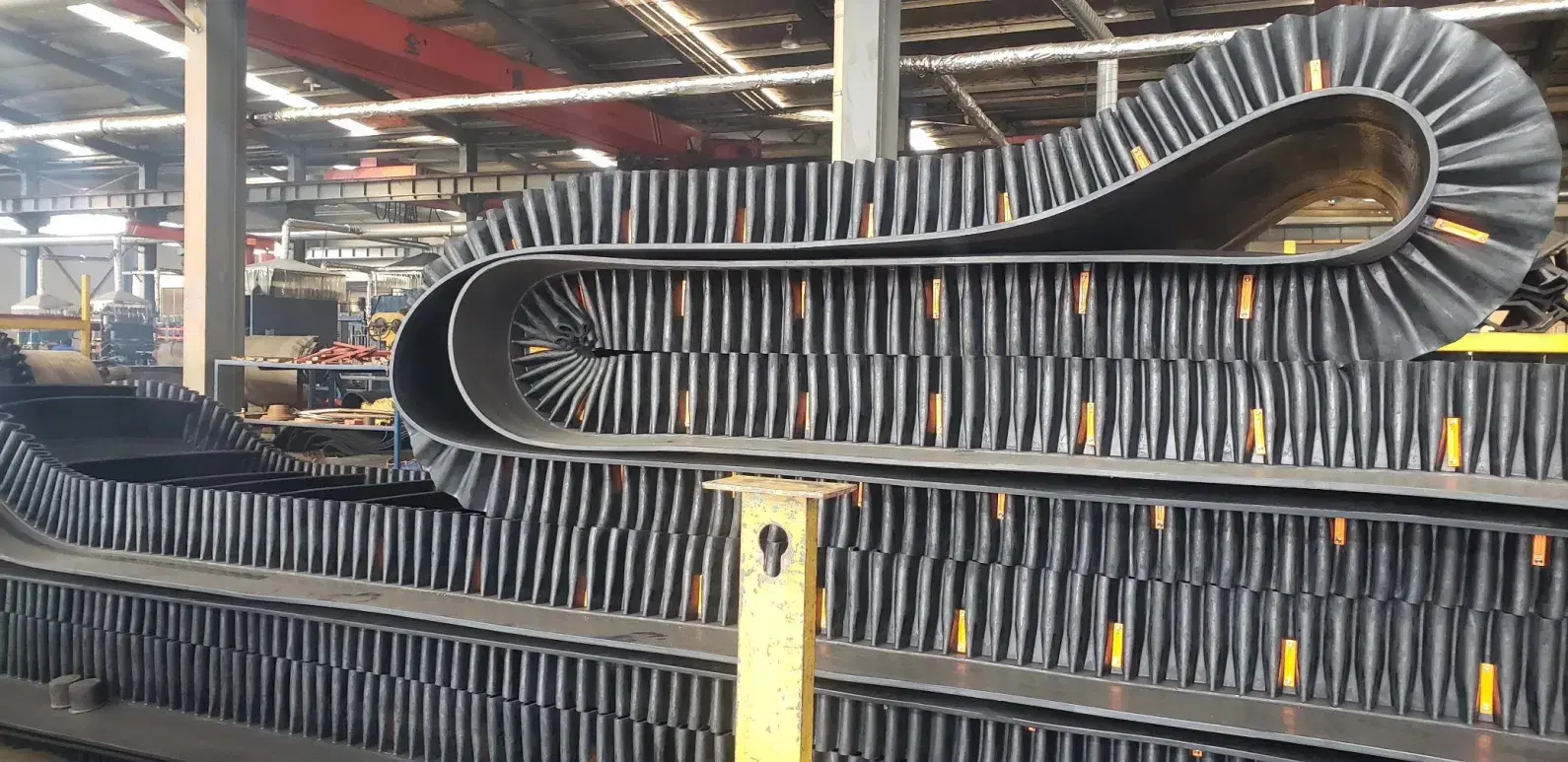
This design becomes useful the moment a facility needs to move material somewhere a flat belt can’t reach efficiently, whether that’s up several floors, over an obstacle, or through a space too narrow for a long, gradually inclined run.
| Base Belt Width B (mm) | Sidewall Height H (mm) | Cleat Height H1 (mm) | BF (mm) | Br (mm) | B (mm) |
| 300 | 40 | 35 | 25 | 180 | 35 |
| 60 | 55 | 50 | 120 | 40 | |
| 80 | 75 | ||||
| 400 | 60 | 55 | 50 | 180 | 60 |
| 80 | 75 | ||||
| 100 | 90 | ||||
| 500 | 80 | 75 | 50 | 250 | 75 |
| 100 | 90 | ||||
| 120 | 110 | ||||
| 650 | 100 | 90 | 50 | 350 | 100 |
| 120 | 110 | ||||
| 160 | 140 | 75 | 300 | ||
| 800 | 120 | 110 | 50 | 460 | 120 |
| 160 | 140 | 75 | 410 | ||
| 200 | 180 | ||||
| 1000 | 60 | 140 | 75 | 550 | 150 |
| 200 | 280 | ||||
| 240 | 220 | ||||
| 1200 | 160 | 140 | 75 | 690 | 180 |
| 200 | 180 | ||||
| 240 | 220 | ||||
| 300 | 280 | 105 | 630 | ||
| 1400 | 200 | 180 | 75 | 830 | 210 |
| 240 | 220 | ||||
| 300 | 280 | 105 | 770 | ||
| 400 | 360 | ||||
| 1600 | 200 | 180 | 75/105 | 970 | 240 |
| 240 | 220 | ||||
| 300 | 280 | 75 | 910 | ||
| 400 | 360 | ||||
| 1800 | 240 | 220 | 105 | 1110 | 270 |
| 300 | 280 | 125 | 1050 | ||
| 400 | 360 | ||||
| 500 | 460 | 1010 |
How Sidewall Belting Saves Space in Vertical Conveying
Here’s the part that actually changes a plant layout. A flat conveyor moving material upward can typically only handle a shallow angle, somewhere around 15 to 20 degrees, before material starts sliding back. To gain real height, you need a long horizontal run to build up to that angle gradually. That eats a lot of floor space for what amounts to moving material up one level.
Sidewall conveyors change that math. Because the sidewalls and cleats contain the material, these systems can run at much steeper angles, in some cases close to vertical, without losing product off the back of the belt. That means the same vertical lift can happen in a fraction of the horizontal distance.
For facilities working in tight buildings, older sites that were never designed with modern material flow in mind, or plants trying to add capacity without expanding the building footprint, that difference matters. It’s not just about saving space either. Shorter conveyor runs mean less structural steel, fewer support points, and often lower long-term maintenance costs compared to running a much longer flat system to achieve the same lift. This is different from how a standard nylon fabric conveyor belt is typically deployed, where the assumption is usually a flatter, longer run rather than a steep vertical transition.
Plant layouts get more flexible too. Once you’re not locked into long, shallow inclines, you can route material through a building in ways that weren’t possible before, working around existing equipment instead of redesigning everything from scratch.
Benefits of Corrugated Sidewall Belting for Material Handling
The advantages go beyond just fitting into a tighter space. Once a plant switches to sidewall belting for an incline or vertical run, the practical gains show up in a few specific ways.
Better Material Containment
The correct choice of each component in relation to the final use is one of the most important contribution to the overall plant performances.
The complete range of MONSTER belts is produced according to the international standards; therefore the cross reinforcement of the carcass ensures the necessary transversal stiffness and prevents from hitting the full width return idlers.
Sketches on the right show typical but not exhaustive Flexobord layouts; the belt designer must take into consideration these alternatives to guarantee correct plant performances.

The sidewalls are doing more than just looking sturdy. They physically keep bulk material on the belt, which matters a lot with loose, granular, or irregularly shaped loads that would otherwise spread out and fall off the edges on an incline.
This containment also reduces spillage, which means less material lost, less cleanup, and less material buildup around the base of the conveyor that eventually becomes a housekeeping and safety issue.

BASE BELT SELECTION
According to the heaviness of the application, the following base belt typologies are available:
1.XE / XE+2 Textile fabrics with high transversal stiffness, feature provided by 2 additional special
synthetic layers set in the cover rubber, assure the correct cross stabilizing properties. They are provided with cut edges for light and medium applications.

- XE-SC+2 Composed by a mix of multi-ply synthetic carcass and suitable steel reinforcement to ensure high transversalstiffness for heavy Flexobord applications.They are provided only with moulded edges.This cross stabilized base belt can be sold as independent product ,The sketch shows the unique difference compared the presence of transversal steel cord in the cover.

- XSTSC Designed for the heaviest applications where high elevation and/or conveying capacity are involved, it is composed by longitudinal steel cords with a special transversal steel reinforcement to assure the required stiffness. Full range is available from 800 to 3500 KN/m; for the correct belt selection, please contact our technical dept.This cross stabilized base belt can be sold as independent product ,This belt type has a steel cords internal structure.

Base belt, sidewalls and cleats can be provided with alternative rubber covers with reference to the specific application.
Sidewalls and cleats are produced with the same compound of the base belt.
ABRASION RESISTANT SIDEWALLCONVEYOR BELT
(L grade ISO 10247 – Y grade DIN 22102 – RMA II grade)
– Standard abrasion resistance compound:
Abrasion sidewall is a cover rubber recommended for all ground applications and for the majority part of the materials, where resistance to abrasion is required. ZHENXING belts with ABRASION compounds are suitable to handle heavy and/or abrasive material such as gravel, stone, sand, aggregates, coal, cement, etc.
(D grade ISO 10247 – W grade DIN 22102 – RMA I grade)
– Extra abrasion resistance compound:
High Abrasion is superior quality cover rubber, especially designed where maximum resistance to abrasion is required. The characteristics of resistance to cut, tear and ozone cracking, together with long duration, improve the quality of this cover. it is expressly recommended for steel works and iron mines; however, it is recommended for heavy lump ore, coke, salt, limestone too.
FIRE RESISTANT SIDEWALLCONVEYOR BELT
(K grade DIN 22102, class 2A EN 12882)
– Self-extinguish product: FR Sidewall belt is a product designed to service both underground and above ground application where safety is fundamental and fire risk is high. It is recommended in particular for coal and potash applications. it is self-extinguish and antistatic according to ISO 340 and ISO 284 or equivalent.
(K+G grade DIN 22102, class 2A EN 12882)
– Self-extinguish and oil resistant product:
FRMOR: is a nitrile rubber, it provides superior resistances to vegetable oils and animal fats; it is also self-extinguish and antistatic according to ISO 340 and ISO 284, or equivalent in order to guarantee high safety to the conveyor plant.
Flexible Conveyor Configurations
Because sidewall systems can handle changing elevation without needing a long, gradual approach, they give engineers more freedom to design around whatever constraints the site has. A plant expansion doesn’t need to follow the same layout logic as a flat conveyor system would demand.
The right configuration still depends on matching the belt to the material and the layout, not just picking sidewall belting because it sounds more capable. A poor match between belt design and actual operating conditions causes more problems than it solves, and this is where a lot of buyers get it wrong by assuming one sidewall design fits every incline application. Belt strength matters here too, and looking at how steel cord conveyor belt construction handles high-tension, heavy-load scenarios gives a useful comparison point when a project calls for both steep angles and heavy throughput.
Choosing the Right Sidewall Conveyor Belt Design
There isn’t one universal sidewall belt that fits every job. A few things need to line up before picking a design.
Material characteristics. Fine powders behave differently than coarse aggregate on an incline. Sidewall height and cleat spacing both depend on what’s actually being moved.
Incline angle. Steeper angles need taller sidewalls and different cleat profiles than a moderate incline. Getting this wrong means material spillage even with sidewalls in place.
Capacity requirements. How much material needs to move per hour affects belt width, speed, and sidewall dimensions. Undersizing this leads to bottlenecks; oversizing it wastes money on unnecessary belt capacity.
Conveyor dimensions. The overall length, height, and transition points on the conveyor all influence which belt construction can physically handle the job without excessive wear at the flex points.
Sidewall height and cleat configuration should always be selected to match the specific application rather than defaulting to a standard size. Belt construction needs to suit the operating environment too, since a belt rated for light indoor use won’t hold up in a dusty, abrasive outdoor quarry setting. Working with experienced sidewall conveyor belt manufacturers rather than guessing at specifications tends to save a lot of trouble down the line, particularly on steep or high-tonnage applications where a mismatch shows up fast.
Industries That Use Sidewall Conveyor Systems
Sidewall conveyors show up across a range of heavy material handling settings, usually wherever vertical lift or limited space is part of the challenge.
Mining and mineral processing rely on these systems to move ore and processed material between levels, especially where underground or shaft-based operations have real space constraints.
Quarry and aggregate handling operations use sidewall belting to lift crushed stone and aggregate between processing stages without needing long, gradually inclined runs across the site.
Cement and other bulk-material industries use these conveyors to move raw material and finished product through vertical processing stages, often in facilities where building height matters more than floor space.
Recycling and industrial material handling applications benefit from the containment properties too, since sorted or mixed waste streams tend to be irregular in shape and prone to spilling off a flat belt on any kind of incline.
If your operation is working through a layout that needs vertical lift without eating up more floor space, it helps to talk through the actual site conditions before settling on a belt design. Contact us and we can help figure out the sidewall height, cleat spacing, and belt construction that actually fits what you’re moving and where you’re moving it.