
 Chevron Patterned Rubber Conveyor Belt

We are a nation chemical designated enterprise in rubber conveyor belt line and ISO certified manufacturer and exporter of superior quality conveyor belts, which are also called as conveyor belting. These conveyor belts are compatible with long distance conveying with high load, speed & impact. These conveyor belt find usage in diverse industries for material handling applications.
Picking a conveyor belt isn’t really about picking a belt. It’s about matching a set of specifications to a job, the incline, the material, the throughput, and everything else that decides whether the belt lasts three years or three months. Skip that step and even a well-made belt can end up being the wrong belt for what it’s actually doing. Getting the Chevron belt specification right matters just as much here, especially on inclined runs where flat belting starts losing material almost immediately.
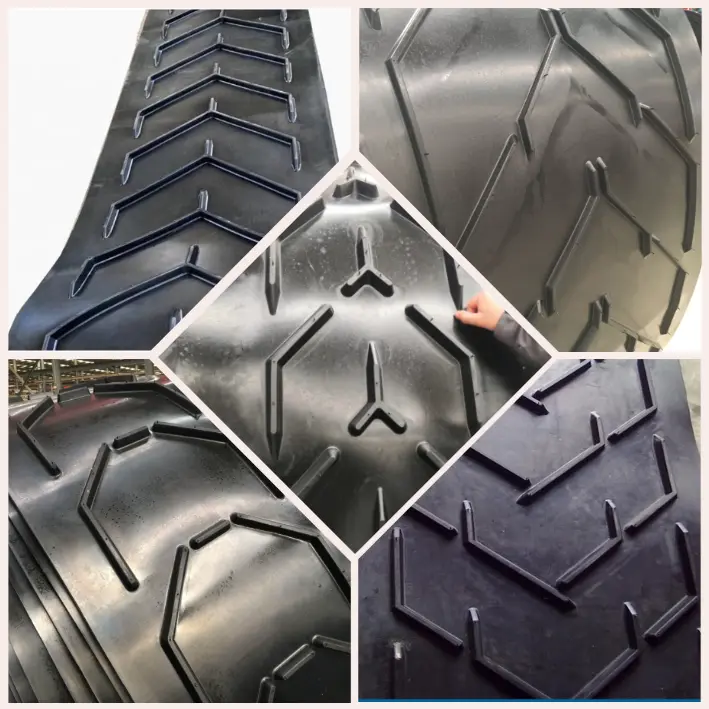
On the surface of the belt, there is chevron pattern higher than the belt bodyd.The pattern may be eitheropen-end or closed. Each kind of patte rn includes three types: high, medium and low.
What Is a Chevron Conveyor Belt?
A chevron belt has a raised pattern molded right into the belt surface, usually shaped like a series of V’s or arrows pointing in the direction of travel. That’s the “chevron” part. Some designs use straight cleats instead, but the purpose is the same either way.
V Y Type Patterned Chevron Rubber Conveyor Belts for Small Lump Materials
- Chevron Pattern Design: Open-end or closed patterns with high, medium, and low types for inclinations up to 40 degrees.
- Multi-Material Options: Available in EP, NN, CC, TC fabrics with polyester, nylon, carbon fiber, or cotton carcasses.
- Extreme Resistance: Features oil, acid, alkali, tear, heat, cold, and wear resistance for harsh environments.
- International Standards: Complies with DIN 22102, AS 1332, RMA, IS 1891, BS 490, and JIS K 6322 standards.
- High Tensile Strength: Strong tensile strength ranging from 15 to 25 Mpa depending on the specific cover grade.
Key Chevron Belt Specifications to Check
Once you know a chevron belt is the right general category, the actual spec sheet is where the real decisions happen. A few numbers matter more than the rest.
Chevron Profile and Cleat Height
The right height depends on two things mainly, what the material actually looks like and how steep the conveyor runs. Fine sand behaves differently than crushed stone, and a 20 degree incline needs a different cleat than a 30 degree one. Picking cleat height off a general chart without checking these two factors is how belts end up underperforming right out of the gate.
Chevron conveyor belt is suitable for conveying loose, bulky or bagged materials on inclined surface at angles of less than 45 degrees.We have different chevron mould for you choosing. The chevron height is from 5 to 32mm, width can be 400mm to 2000mm. Cleats and top cover rubber are vulcanized integrally, it is very stable, and cleat pattern, angle and pitch are designed elaborately and beautiful. We have more than 40+ kinds of different patterns that can meet the needs of customers in different countries around the world.


1. Belt types
♦ Types: Open V, Closed-V, Multi-V, L type, H type, Y type, etc.
♦ Chevron Height: C5, V6, C10, V15, C15, Y20, Y25, Y32, etc,.
♦ Width: 400MM-2000MM
♦ Thickness: 4-50mm
♦ Types: EP/NN100-EP/NN800
♦ Feature: Good adhesion and long working life.
2. Technical Data of Rubber Cover:
♦ Tensile Strength: ≥ 15Mpa
♦ Elongation at Break: ≥ 400%
♦ Adhesive strength between carcass: ≥ 6.0N/mm
♦ Adhesive strength between cover and carcass: ≥ 5.0N/mm
♦ Elasticity: ≥ 32%
♦ Abrasion: ≤ 200mm3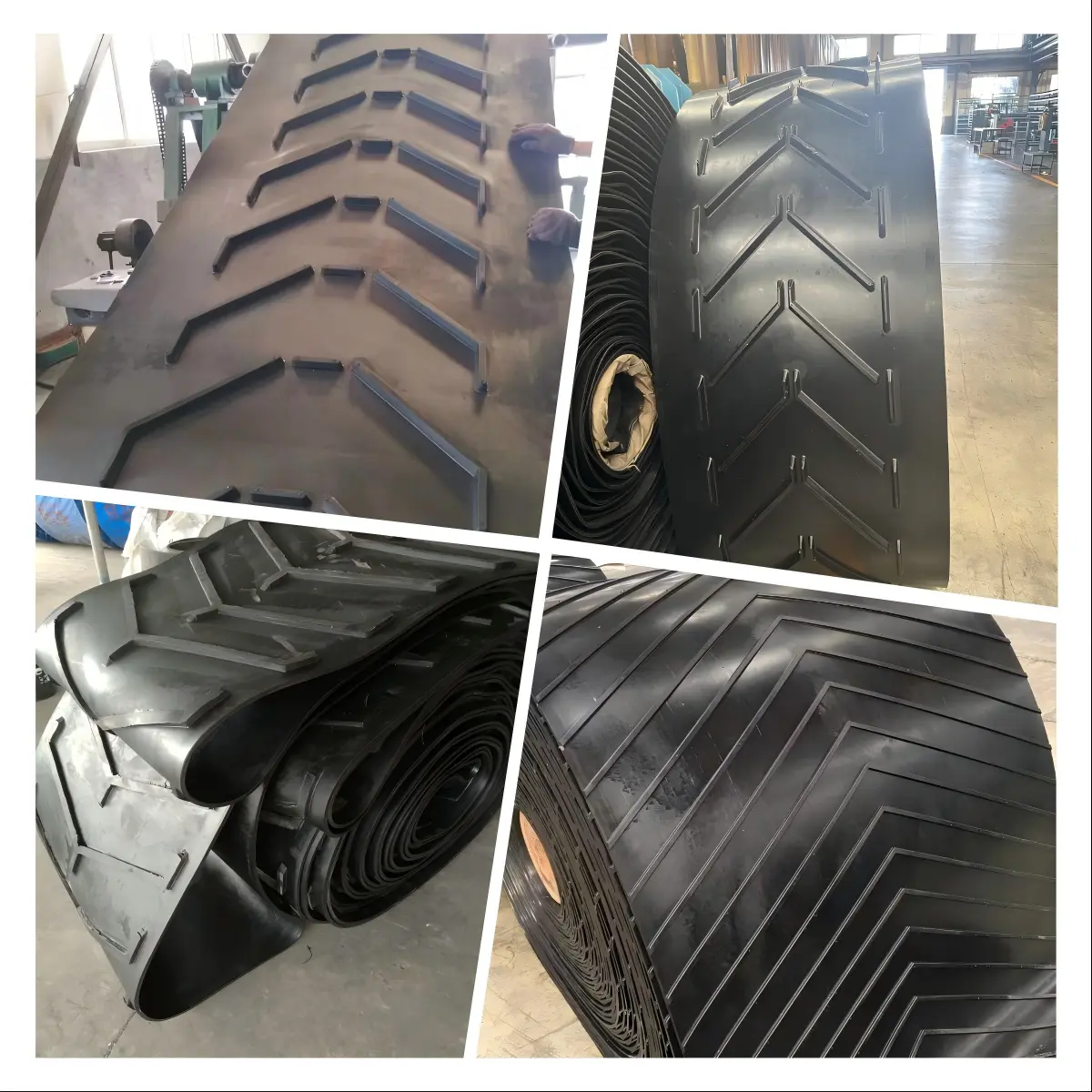
Belt Strength and Construction
Underneath the chevron profile, the belt still has a carcass doing the structural work, usually fabric plies like a solid woven pvc conveyor belt construction or a similar reinforced layup, depending on the application. Tensile strength has to match the load, and that includes not just the weight of material but the length of the conveyor run and the tension building up across it.
Longer runs and heavier loads need higher-rated reinforcement. Skimping here to save money upfront tends to show up later as stretching, premature wear, or outright belt failure, none of which are cheap to deal with once a line is already running.
How Material Type Affects Chevron Belt Selection
The material being conveyed drives most of the decisions above, so it’s worth being specific about it. Fine, granular material like sand or fine aggregate often needs a lower, tighter cleat pattern, since large gaps between cleats let fine material slip through and roll back anyway.
Larger or irregular material, think crushed rock or mixed aggregate, usually needs taller, wider-spaced cleats that can actually catch bigger pieces without getting clogged or worn down by constant impact.
Weight and moisture matter too. Wet, sticky material behaves differently on an incline than dry material does, and it can also build up on the belt surface over time if the profile isn’t suited to shedding it. A chevron cleated conveyor belt chosen without accounting for moisture content often ends up needing more frequent cleaning or replacement than expected.
All of this comes back to matching cleat design and belt construction to what’s actually moving across the belt, not to a generic assumption about “bulk material” as one category. Sand, gravel, and crushed ore are not interchangeable when it comes to spec selection.


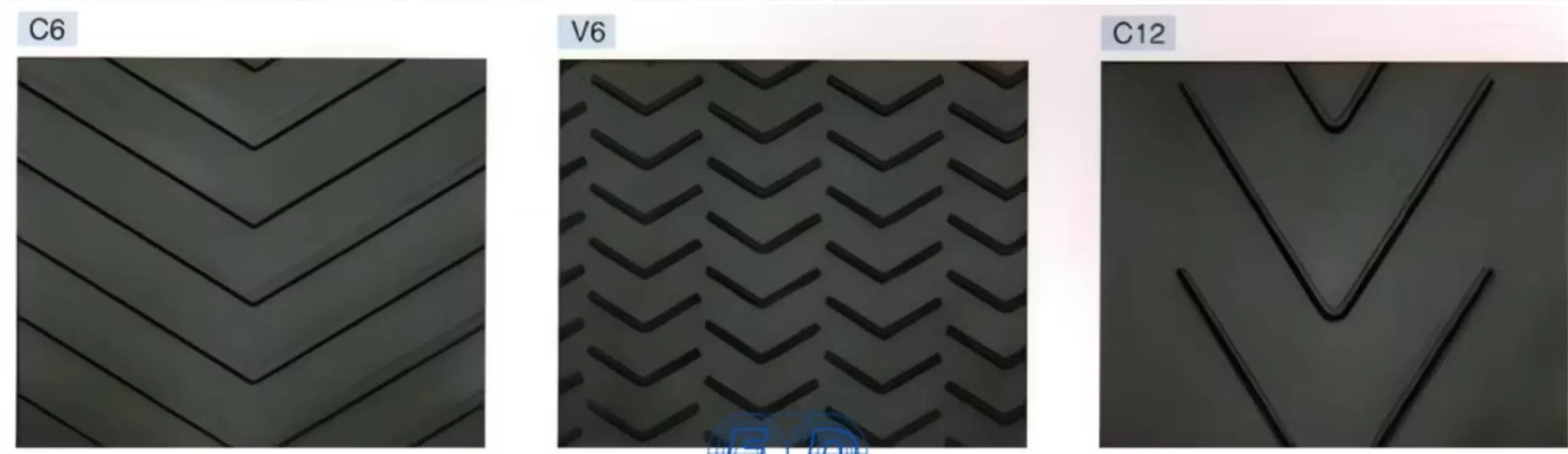
Material: EP/NN/CC/TC
Application: It can convey powdered, granutated and small lump materials at the inclination of no more than 40, it can also convey packaged materials.
Custom Conveyor Belts:
- Anti-split conveyor belts
- Anti-abrasion conveyor belts
- Common conveyor belts
- Acid-alkali resistant conveyor belts
- Heat-resistant conveyor belts
- Cold -resistant conveyor belts
- Oil -resistant conveyor belt
We could offer belt with cover grade in accordance to International standard such as DIN 22102, RMA, AS 1332, SABS 1173/2000, IS 1891, BS 490, JIS K 6322, etc.
| Standards | Cover Rubber | Adhesion | ||||
| Tensile Strength | Elongation at break | Abrasion | Cover to Ply | Cover to Ply | Ply to Ply | |
| DIN 22102 | Mpa | % | mm3 | N/mm (≤1.5mm) | N/mm (>1.5mm) | N/mm |
| DIN 22102-Z | 15 | 350 | 250 | 3.5 | 4.5 | 5 |
| DIN 22102-W | 18 | 400 | 90 | 3.5 | 4.5 | 5 |
| DIN 22102-Y | 20 | 400 | 150 | 3.5 | 4.5 | 5 |
| DIN 22102-X | 25 | 450 | 120 | 3.5 | 4.5 | 5 |
| Standards | Cover Rubber | Adhesion | ||||
| Tensile StrengTD | Elongation at break | Abrasion | Cover to Ply | Cover to Ply | Ply to Ply | |
| AS 1332 | Mpa | % | mm3 | N/mm (≤1.9mm) | N/mm (>1.9mm) | N/mm |
| AS 1332-N17 | 17 | 400 | 200 | 4 | 4.8 | 6 |
| AS 1332-M24 | 24 | 450 | 125 | 4 | 4.8 | 6 |
Matching Cleat Height to Conveyor Incline
Incline angle is arguably the single most important number on the spec sheet, since it drives almost everything else about the belt design. A shallow incline can often get away with a lower profile and less containment. A steep incline can’t.
The goal with cleat height is reducing rollback, material sliding back down the belt instead of reaching the top. Too short a cleat on a steep angle and rollback becomes a constant problem, cutting into actual throughput even if the belt itself is running fine mechanically.
But taller isn’t automatically better either. Oversized cleats on a moderate incline add unnecessary cost and can actually reduce loading efficiency if the material doesn’t need that much containment. Comparing that against options in pvc conveyor belts built for different incline ranges can help clarify where the trade-off actually sits for a given application. The right balance sits somewhere between enough containment to stop rollback and not so much that the belt is overbuilt for the job.
Where Chevron Conveyor Belts Are Used
Chevron belts show up wherever bulk material needs to move up an incline without sliding back, and that covers a fairly wide range of heavy industries.
Mining and mineral handling operations use chevron belts to move ore and processed material up inclined sections between crushing, screening, and stockpiling stages.
Quarry and aggregate applications rely on them to lift crushed stone from lower processing points up to loading or storage areas without needing long, shallow runs.
Sand and gravel processing plants use finer cleat profiles suited to the smaller, looser material typical of these operations.
Cement and other bulk-material handling facilities use chevron belting on inclined transfer points throughout production, where flat belting would struggle to keep material contained.
The application really is what decides the right profile and construction here. A quarry moving coarse aggregate needs a different spec than a sand processing plant, even though both are technically “chevron belt” applications. If you’re working through a spec for a specific incline or material and want to avoid guessing, contact us and we can help match the cleat height, width, and construction to what you’re actually running.