
A quote for a belt often arrives as one line that looks like a part number, something like EP400/4, 5+2, 1000 mm. To someone who reads these every week it says a lot. To someone seeing it for the first time it says almost nothing, and that gap is where wrong belts get ordered. A good fabric belt conveyor setup depends on a handful of numbers lining up, and your supplier can’t check them for you if you don’t know which ones matter.
Understanding a Fabric Conveyor Belt Specification

A spec sheet is the belt’s identity. Width, plies, strength, covers and fabric type all sit in that one line, and together they describe how much tension the belt can take, how it bends over pulleys and how long the covers will last against your material. Change any one of them and you have a different belt, even if the price looks similar.


Ask for the spec in writing before you ask about price. A supplier who gives you a clear, complete one usually understands what the belt is going to be doing.
What Ply Count Means in Fabric Conveyor Belts
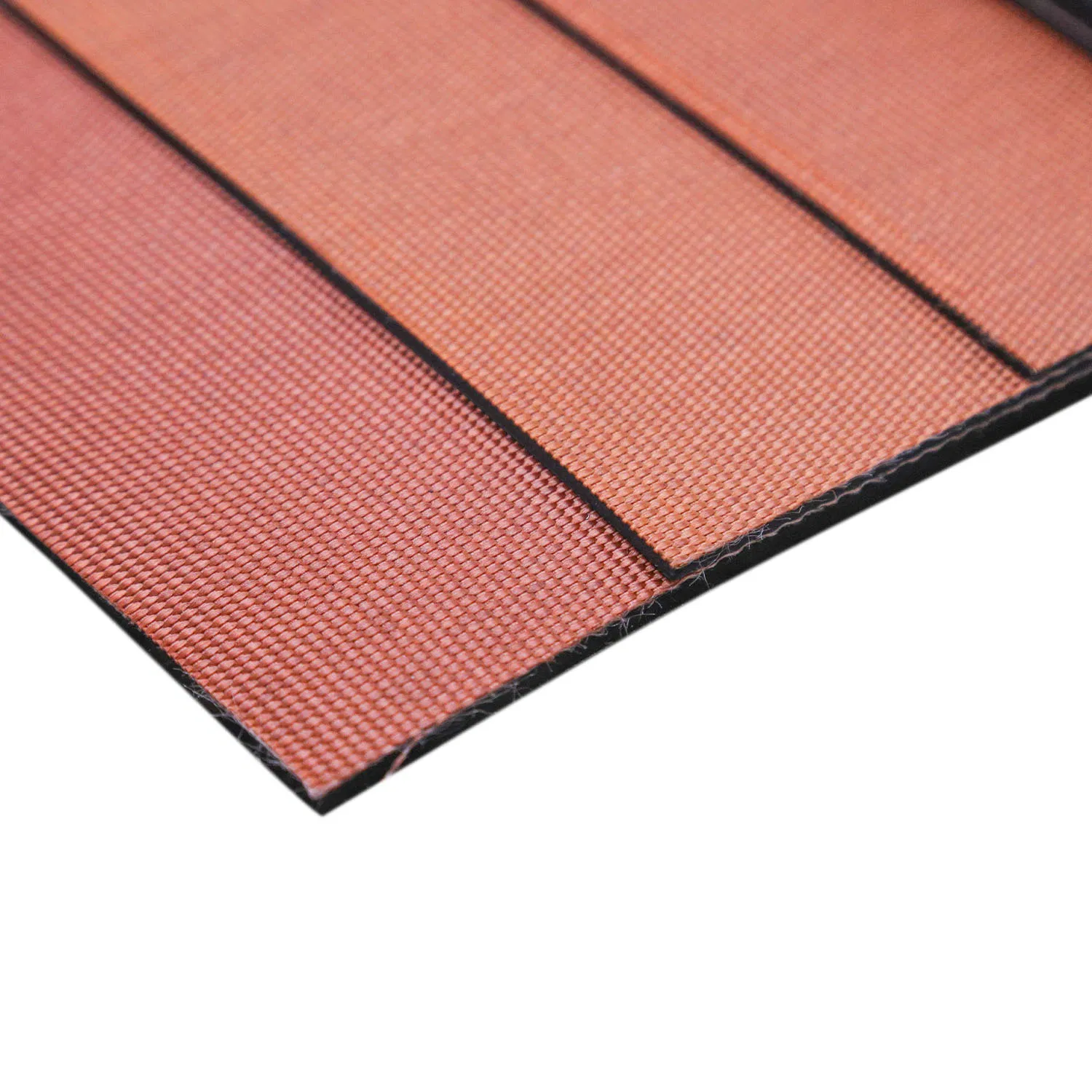
Plies are the layers of woven fabric stacked inside the rubber. Each one carries a share of the tension, so ply count is half of the strength calculation. A belt with four plies of a given fabric can carry roughly twice what a two ply belt of the same fabric can, assuming everything else is equal.
Ply count also changes how the belt behaves. More plies means a thicker, stiffer carcass. That helps with impact and load support, but it hurts troughability, which is the belt’s ability to bend into a trough over the idlers, and it calls for larger pulleys. A narrow belt with too many plies lifts off the center roller and tracks badly. A wide belt with too few sags between idlers and spills.
COMPOUND SPECIFICATIONS
Recommended MINIMUM Cover Thickness
| Class of Material | Top Cover (inches) | Top Cover (mm) | Bottom Cover (inches) | Bottom Cover (mm) |
|---|---|---|---|---|
| NON-ABRASIVE MATERIALS: Wood Chips, Pulp, Grain, Loose Cement, Potash Ore or very fine Coal. | 1/16 to 1/8 | 1.5 to 3.0 | 1/16 | 1.5 |
| MILDLY ABRASIVE MATERIALS: Sharp Sand, Clinker, Earth, Bituminous Coal and Rock under 3″ size. | 1/8 to 3/16 | 3.0 to 4.5 | 1/16 | 1.5 |
| ABRASIVE MATERIALS: Sinter, Gravel, or Crushed Stone. Iron and Copper ores or Limestone under 6″ size. | 3/16 to 1/4 | 4.5 to 6.0 | 3/32 | 2.0 |
| HEAVY ABRASIVE MATERIALS: Iron, Copper, Rock Ores, Zinc, Lead Ores, Limestone or Slag under 9″ size. | 1/4 to 3/8 | 6.0 to 9.5 | 1/8 | 3.0 |
| HEAVY, SHARP ABRASIVE MATERIALS: Trap rock, quartz, Hard Ores, Slag, glass cullet. Any hard heavy sharp ore over 9″ size. | 3/8 to 3/4 | 9.5 to 19.0 | 3/16 | 4.5 |
That’s why more plies is not automatically better. Plenty of buyers ask for an extra ply “for safety” and end up with a belt that won’t trough on their existing idlers. If you want a longer primer on how these belts are built, our guide to Industrial Fabric Conveyor Belts covers the construction in more detail.
For the right ply count, start with the calculated tension on your conveyor and pick the thinnest carcass that meets it with a proper safety margin. Designers often work to a safety factor of around 8 to 10 for fabric belts, which has to cover joint losses as well.
Steel Metal Mesh for Elevator and Sidewall Belts
Steel Breaker Fabric Polyester Cord Fabric, Nylon Cord Fabric
Reading Conveyor Belt Cover Thickness
Cover thickness is written as two numbers, such as 5+2 mm. The first is the top cover on the carrying side and the second is the bottom cover that runs on pulleys and idlers. The top cover is thicker because it takes the loading, the impact and the abrasion. The bottom cover mostly protects the carcass from pulley wear and moisture.
Choose the top cover from the material. Fine sand or grain is easy on rubber, so 3 to 4 mm may do. Crushed stone, ore or anything sharp that drops from height needs 6 mm or more, and a heavy impact point may justify a breaker ply as well. Rubber grade counts as much as thickness. Abrasion loss, measured to DIN ISO 4649, tells you how easily a compound wears away. A DIN W grade loses 90 mm³ or less, X grade 120 mm³ or less and Y grade 150 mm³ or less, so a thick cover in a poor grade can wear out faster than a thinner one in a good grade.
If you’re still working out the whole belt choice, our guide to finding the Best Conveyor Belt Solutions for your plant goes through it step by step.
The bottom cover is the one people shave to save money, and it’s a mistake on conveyors with small pulleys or heavy idler contact. Once the bottom cover wears through, the fabric starts to fray and the belt’s life ends early.
Understanding EP200 and EP400 Conveyor Belt Ratings
EP is shorthand for the fabric. The E stands for polyester in the warp, the lengthwise threads that carry the tension, and the P stands for polyamide, meaning nylon, in the weft across the belt. The number that follows is the nominal tensile strength per ply in N/mm of belt width. EP200 is rated at 200 N/mm per ply and EP400 at 400 N/mm per ply.
Total belt strength comes from multiplying by the number of plies. An EP200 belt with four plies is an 800 N/mm belt. An EP400 belt with two plies reaches the same 800 N/mm with half the layers. That’s the main reason to choose the higher grade fabric. You get the same strength in a thinner, more flexible belt that troughs better and runs over smaller pulleys, though the fabric costs more per ply.
| Spec | EP200, 4 ply | EP400, 2 ply | EP400, 4 ply |
| Total belt rating | 800 N/mm | 800 N/mm | 1600 N/mm |
| Carcass | Thicker, more flexible per ply | Thinner, easier to trough | Thick and stiff |
| Typical use | Medium conveyors, general bulk handling | Same duty with a lighter carcass | Long or high tension conveyors |
Strength should match the conveyor, not the other way round. Work out the maximum tension from capacity, length, lift and drive, apply your safety factor, then pick fabric and plies that exceed it. A heavier rating than you need adds cost, and a lighter one stretches the belt and pulls joints apart.
How Fabric Construction Affects Conveyor Belt Performance
Polyester gives low stretch under load, which is what you want in the warp, because a belt that elongates a lot needs long take-up travel and works its joints loose. Nylon in the weft adds flexibility across the width and good impact resistance, so the belt troughs well and copes with lumps dropping on it. That mix is why EP dominates mining and bulk handling.
Pure nylon belts stretch more and take up more moisture, which suits shorter conveyors with high impact but is a poor choice for long runs. Pure polyester belts hold up better in wet conditions but are less forgiving under heavy shock.
A solid woven carcass is a different animal. A pvc conveyor belt uses a single thick woven body impregnated with PVC instead of separate plies, so ply count never appears in its spec. Comparing a ply belt with a solid woven belt by ply count makes no sense, and it’s a common reason quotes don’t line up.
For long overland conveyors, ask for the elongation figure at working load. On a short feeder it hardly matters, but on a long belt a few extra percent of stretch means a take-up the length of a house.
Checking a Fabric Conveyor Belt Specification Before Ordering
Put quotes side by side and compare four things first. Belt width, ply count, tensile rating and cover thickness. Then check the details people skip. How the rating is stated matters, because some quotes give strength per ply and others give the total, and mixing them up is one of the easiest ways to buy a belt half as strong as you thought.
Next, confirm the length and the joint. Say whether you want an endless belt or a belt with a field splice, and what type. A vulcanized joint is stronger than a mechanical one, and the splice length depends on the ply count, so a thicker carcass needs more room. Add the splice allowance to the length instead of ordering the exact loop and finding it short.
Mismatches turn up again and again. Covers are quoted for the top only, tolerance on width isn’t stated, the fabric type is missing, or a belt rated for general use is sold for hot, oily or wet material. If your conditions include heat, cold, oil or fire risk, say so in the first message, because they change the compound and sometimes the carcass.
Send the spec you plan to buy before you commit. If you’re comparing quotes and something doesn’t add up, connect to us with the belt width, conveyor length, lift, material and operating conditions, and we’ll check the numbers and suggest a fabric, ply count and cover that fit.